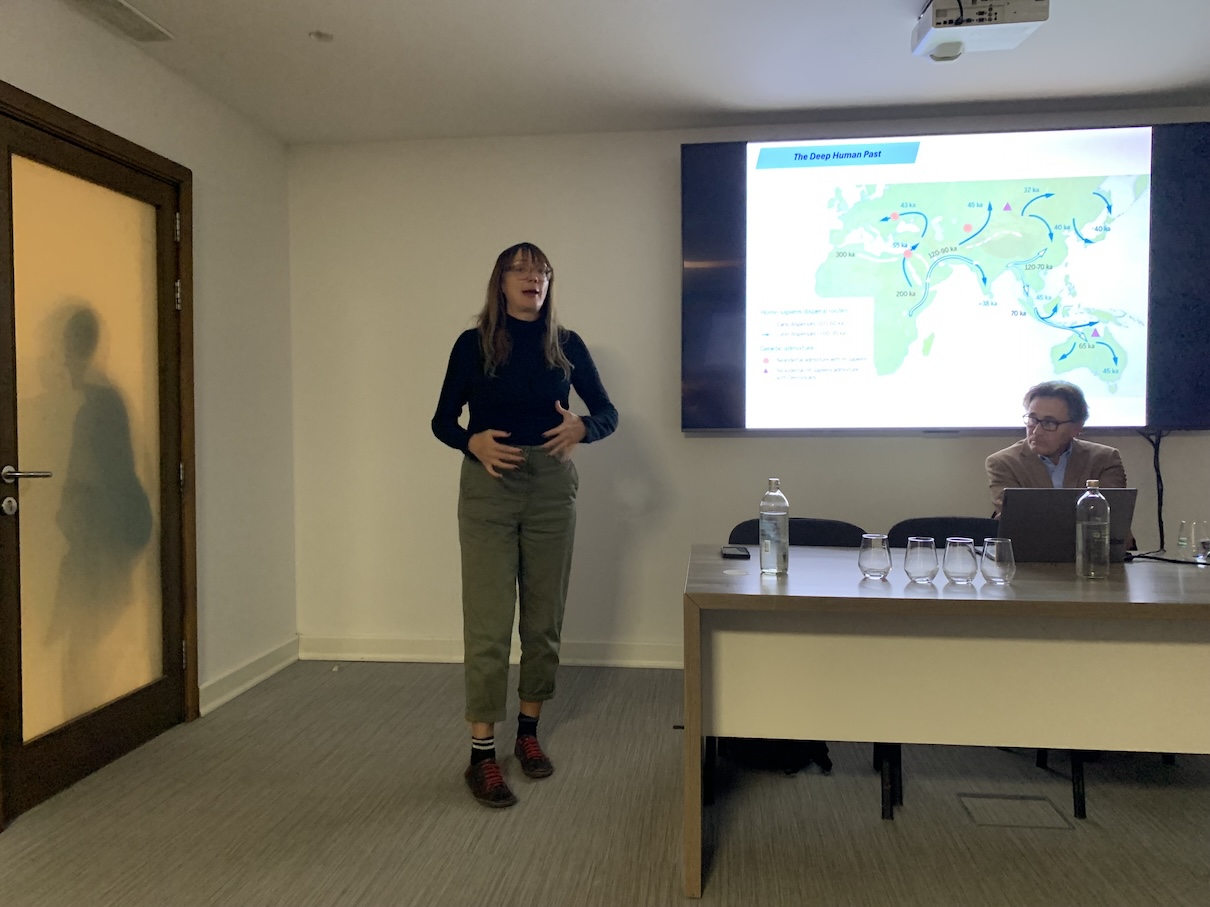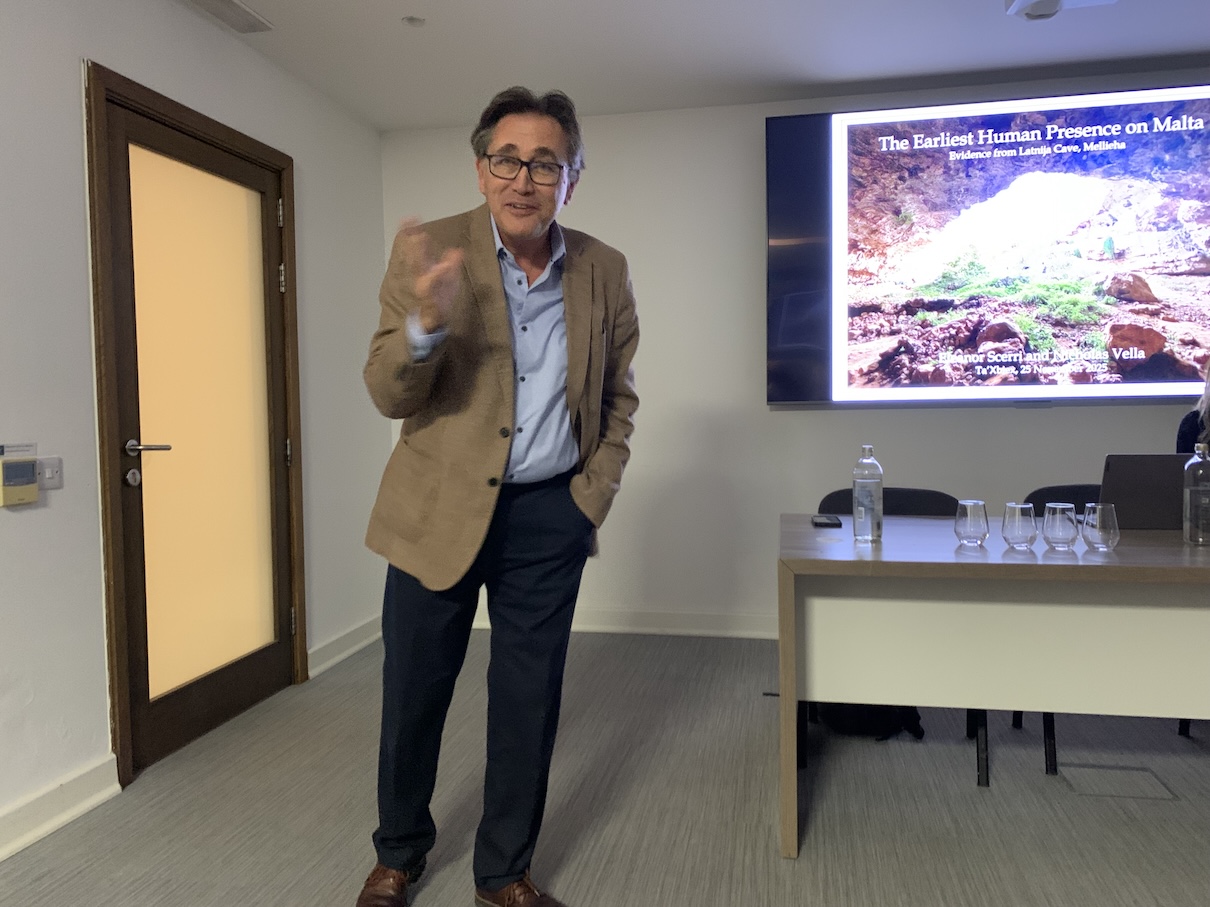
On Tuesday, 25th November 2025, Rotary La Valette hosted a fellowship talk that illuminated one of the most significant archaeological discoveries in Malta’s history. Professors Eleanor Scerri and Nicholas Vella presented the results of excavations at Latnija Cave in Mellieħa, a site that has dramatically reshaped our understanding of the island’s earliest inhabitants.
The Latnija Cave project, initiated in 2019 and publicly announced in April 2025, has revealed evidence of human activity dating back 8,500 years—pushing Malta’s prehistory back by a whole millennium. This breakthrough was made possible through the vision and support of Christopher Foyle OBE (1943–2022), whose interest in Malta’s deep past helped fund the exploration.
Latnija Cave itself is a doline, a collapsed cavity formed by karstic activity, measuring approximately 50 by 70 metres. Initial excavations began with a modest 1m x 1m trench, but quickly expanded to a 5m x 5m dig as evidence of human presence emerged. Archaeologists uncovered deer bones, tortoise shells, lizard remains, fox bones, and even monk seal remains—many showing signs of burning and cooking. Thick ash deposits and charred animal remains confirmed the use of fire, while flake tools made from limestone and beach cobbles demonstrated technological adaptation. Plant remains further revealed an open shrubland.
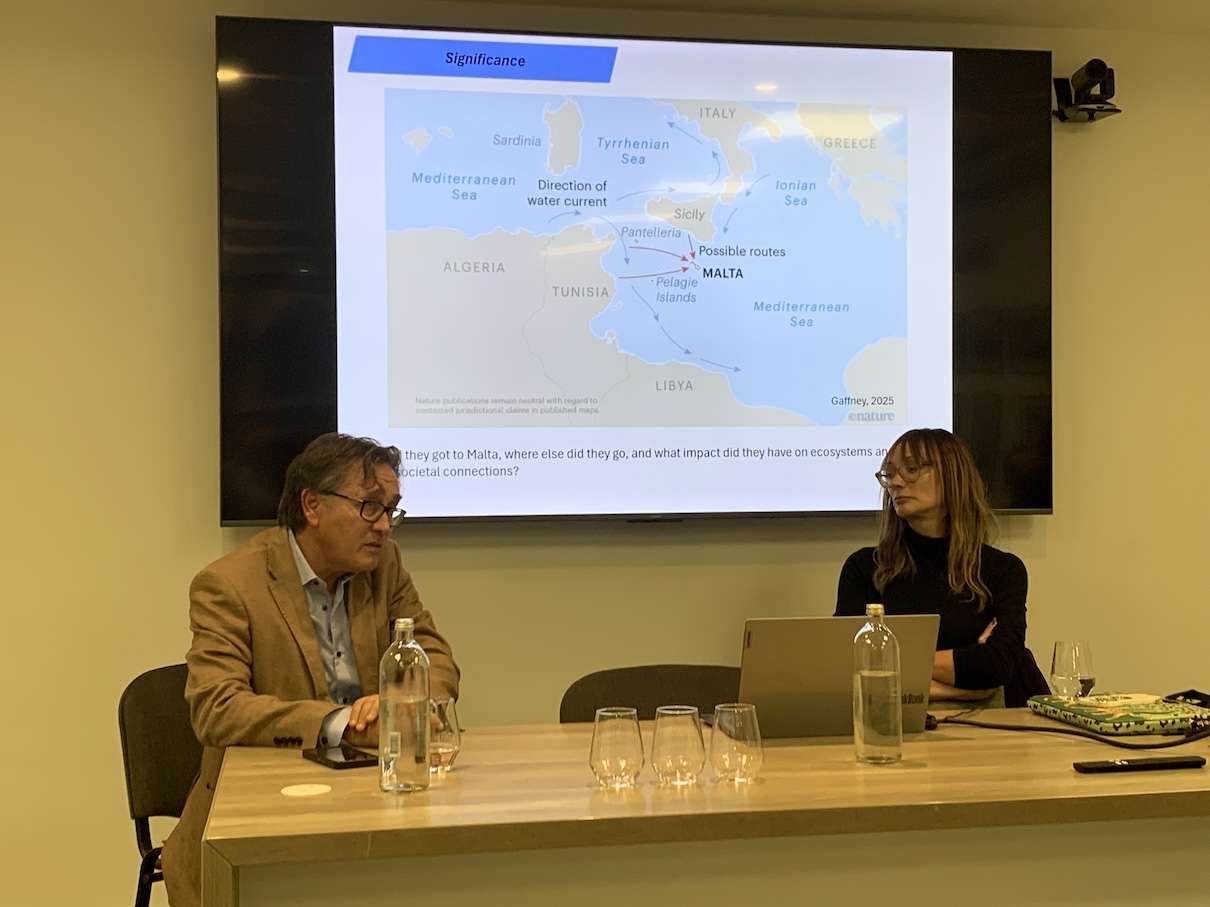
Carbon dating of multiple specimens confirmed that Malta’s earliest human activity occurred around 8,500 years ago, during the Mesolithic period. This era marked the twilight of Europe’s hunter-gatherers, just before the dawn of agriculture. The evidence suggests that small bands of seafarers crossed significant distances across the Mediterranean to reach Malta, navigating currents and sourcing drinking water without sails. Comparable finds at La Marmotta near Lake Bracciano in Italy provide clues to the types of boats used—likely dugout canoes capable of long voyages.
Prof. Scerri, an archaeological scientist at the Max Planck Institute for Geoanthropology, emphasised that these discoveries contribute to broader questions about human dispersal, adaptation, and resilience. Her European Research Council-funded IslandLab project is rewriting the prehistory of Malta and the Mediterranean by combining archaeology with climate science, genetics, and computational methods. Prof. Vella, from the University of Malta, highlighted the importance of Latnija Cave for student training and advancing Mediterranean archaeology.
The implications of this research are profound. Malta, long recognised for its Neolithic temples and Bronze Age heritage, now emerges as a key site for understanding Mesolithic seafaring and island colonisation. The discovery underscores the ingenuity of early humans, who ventured across open seas to settle new lands, reshaping ecosystems and cultural landscapes.
Rotary La Valette’s fellowship talk not only celebrated this scientific achievement but also reflected on Malta’s enduring role in humanity’s story. From the Neolithic discoveries of 1913 to today’s cutting-edge research, Malta continues to inspire curiosity and pride in its place at the crossroads of history.
Your donation can play a vital role in supporting our various initiatives as every euro goes straight to projects. By joining forces with us, you become part of a worldwide community dedicated to creating positive change. Regardless of size, every contribution helps Rotary advance its humanitarian efforts, fostering goodwill and understanding among diverse communities. Your support enables us to continue our impactful projects, empowering individuals and transforming lives. Together, we can build a better future for those in need.
If you would like to donate to support the Club’s work and projects, you can do so through a direct bank transfer to the following Bank Account, specifying “Club Donation” when effecting the transfer. You are also encouraged to write to us on: [email protected] so that we may acknowledge your donation personally. Thank you.
Bank account details:
Account Name: Rotary Club La Valette Malta
Bank: HSBC Bank Malta plc, High Street, Sliema, Malta
Account No: 006 123467 001
Sort Code: 44060
IBAN: MT35MMEB44060000000006123467001
Swift Code: MMEB MTMT