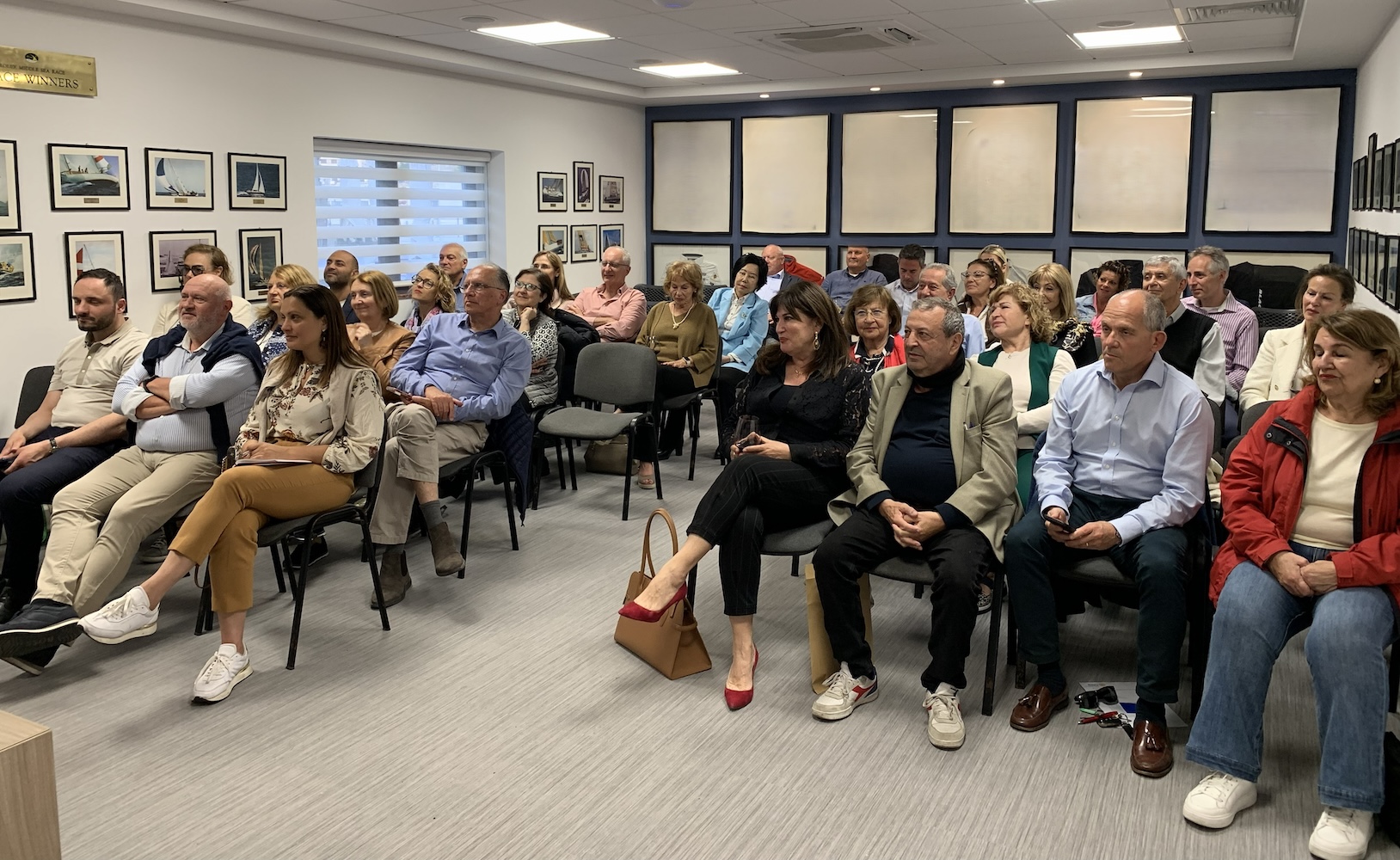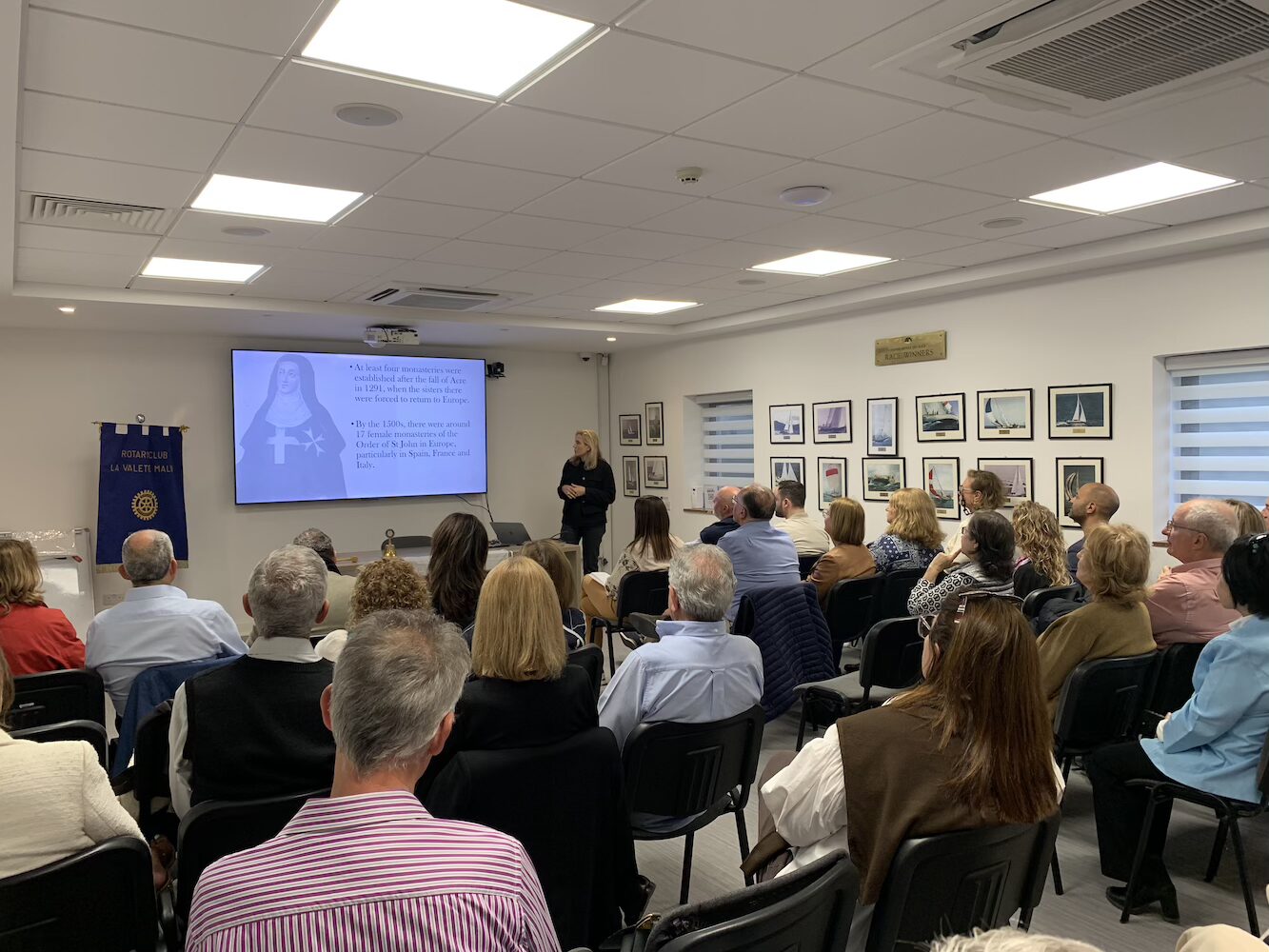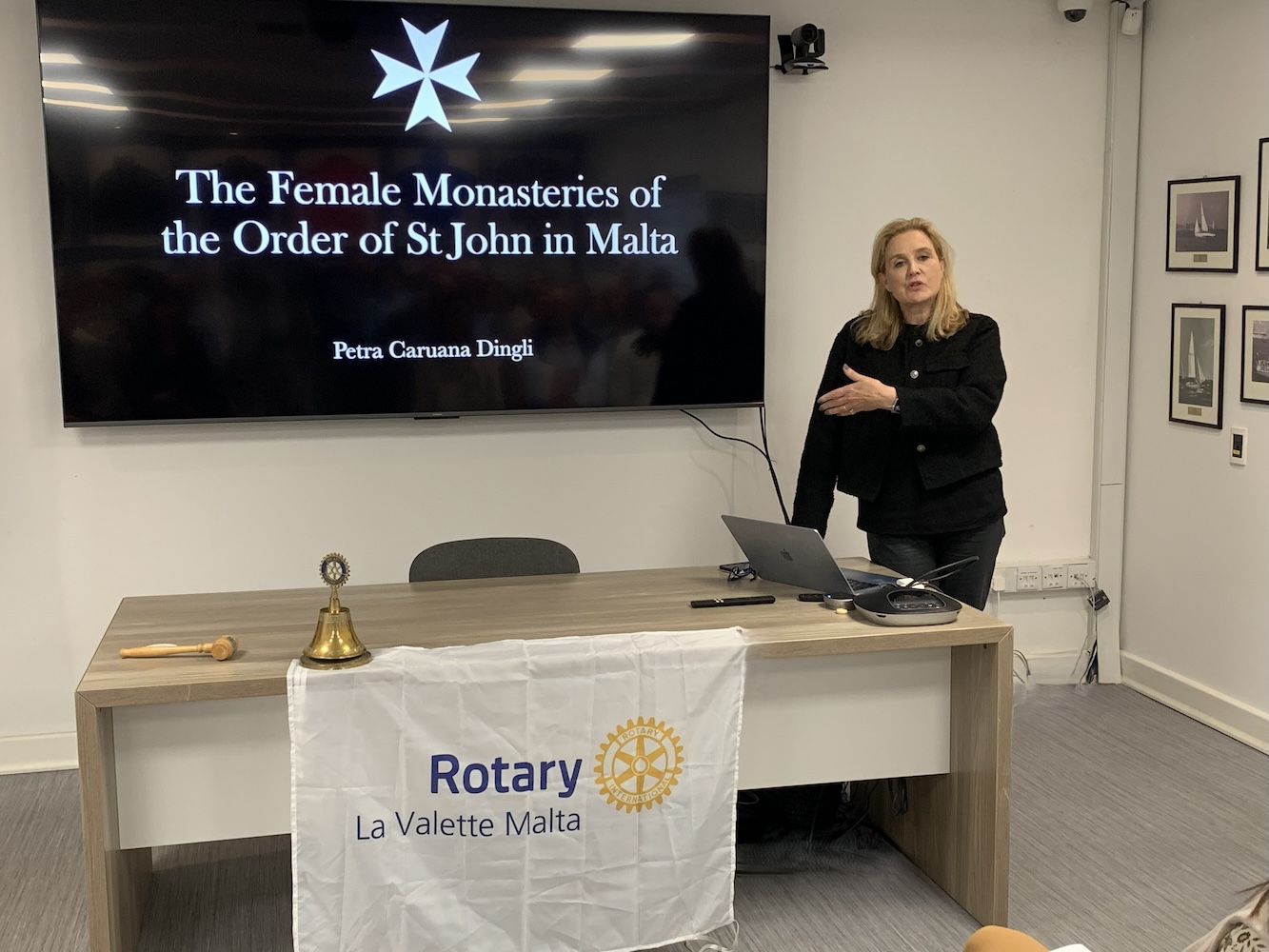
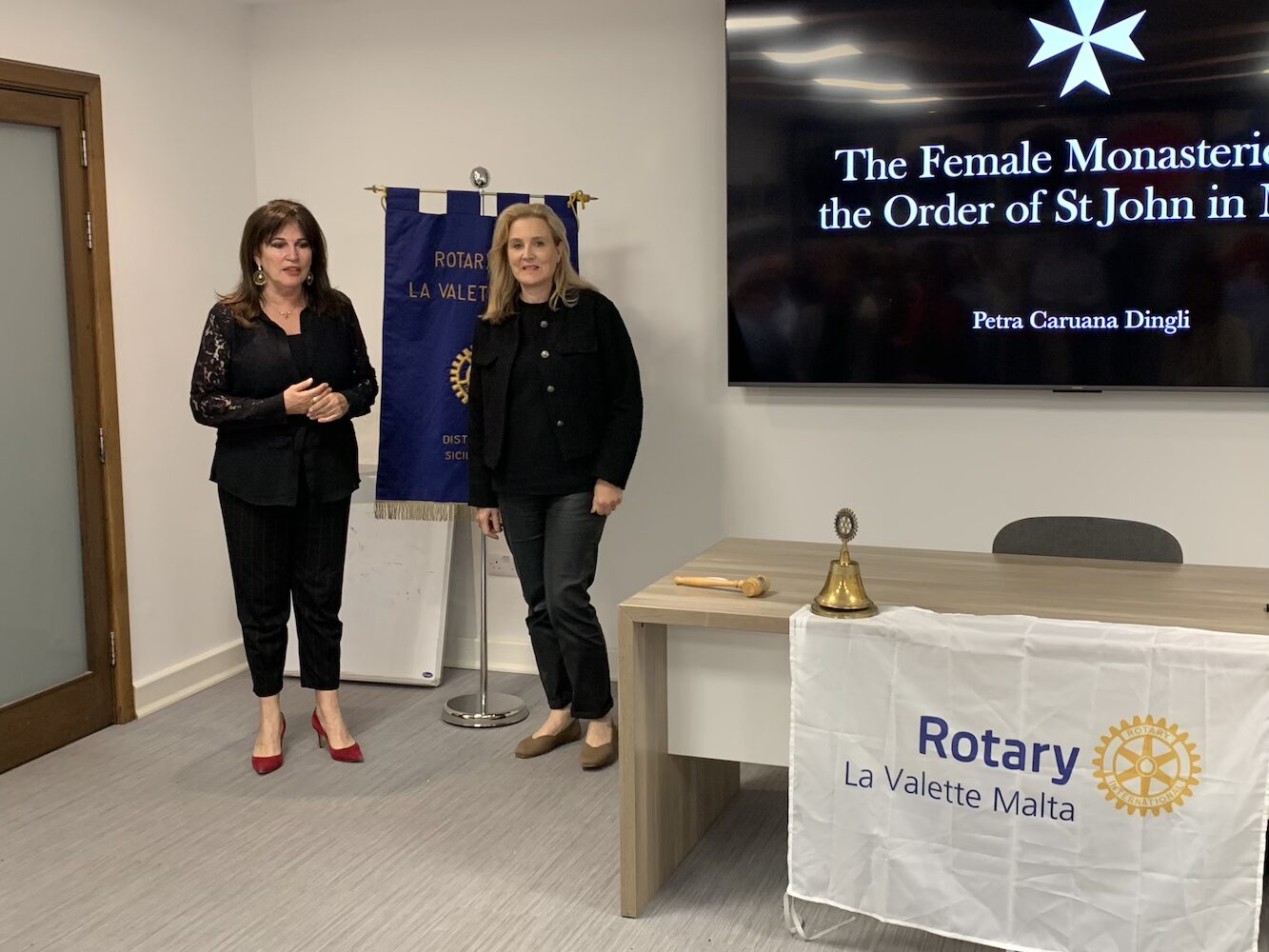
On Tuesday, 28 April, members of Rotary Club La Valette gathered at the Royal Malta Yacht Club for an engaging and well‑attended talk by Prof. Petra Caruana Dingli, a member of the Club. Partners, friends, and visiting Rotarians from Pescara, Italy, joined for an evening that shed new light on a lesser‑known dimension of the Order of St John: its female monasteries and their role in Malta and across Europe.
Prof. Caruana Dingli opened by noting that although the Order is traditionally associated with its military and hospitaller missions, women formed part of its structure from its earliest years. As she explained, “female religious communities were established across Europe from the 12th century onwards,” supporting hospitals, caring for pilgrims, and contributing to the Order’s spiritual life. Following the fall of Acre in 1291, many of these communities relocated to Europe, eventually forming around seventeen monasteries by the 16th century.
The lecture traced the development of these houses in France, Spain, Portugal, and Italy. Notable examples included Beaulieu in Provence—whose nuns, like the Knights, had to prove eight quarters of nobility—and the royal monastery of Sijena in Spain, founded in 1188 by Queen Sancha of Castile. Italian communities, such as those in Pisa and Verona, were linked to important female saints of the Order, including St. Ubaldesca and St. Toscana.
Turning to Malta, Prof. Caruana Dingli highlighted the island’s own monastic traditions predating the Knights, such as St Peter’s Monastery in Mdina. The Order formally established its first female monastery in Malta in 1582 under Grand Master Hugues Loubenx de Verdalle. Initially located in Birgu and later transferred to Valletta, St Ursula Monastery was founded with the help of two Franciscan nuns from Syracuse. The Maltese nuns held a unique status: they wore the full eight-pointed cross, were equal in rank to the chaplain brothers, and were directly subject to the Grand Master.
The talk also touched on St Mary Magdalene Monastery, founded in 1594 for convertite and repentite women seeking refuge from exploitation or hardship—an early example of structured social welfare in Malta.
Prof. Caruana Dingli concluded by emphasising that these communities were not peripheral but central to the Order’s charitable and spiritual mission. Today, St Ursula Monastery remains one of the few surviving female houses directly linked to the Order of St John.
Your donation can play a vital role in supporting our various initiatives as every euro goes straight to projects. By joining forces with us, you become part of a worldwide community dedicated to creating positive change. Regardless of size, every contribution helps Rotary advance its humanitarian efforts, fostering goodwill and understanding among diverse communities. Your support enables us to continue our impactful projects, empowering individuals and transforming lives. Together, we can build a better future for those in need.
If you would like to donate to support the Club’s work and projects, you can do so through a direct bank transfer to the following Bank Account, specifying “Club Donation” when effecting the transfer. You are also encouraged to write to us on: [email protected] so that we may acknowledge your donation personally. Thank you.
Bank account details:
Account Name: Rotary Club La Valette Malta
Bank: HSBC Bank Malta plc, High Street, Sliema, Malta
Account No: 006 123467 001
Sort Code: 44060
IBAN: MT35MMEB44060000000006123467001
Swift Code: MMEB MTMT